














Every release of your mobile app, tested the way an attacker would.

Ostorlab logs in, gets past TLS pinning and obfuscation, and tests the APIs behind your app, on the build you ship. An agentic penetration test takes a few hours, and each AI-agent finding comes with a working exploit you can replay.

  • Gets in: login, one-time codes and multi-factor (2FA/OTP)
  • Gets past: the build you ship, with TLS pinning and obfuscation
  • Goes through: backend APIs and business-logic flaws such as broken access checks
  • Proves: a working exploit you can replay for each AI-agent finding

Why Ostorlab Agentic Deep Scan

Find vulnerability classes that periodic testing and legacy detection techniques often miss, especially where exploitability depends on flow logic and runtime behavior.

Advanced Detection

Advanced Detection

Find vulnerability classes that periodic testing and legacy detection techniques often miss — logic flaws in authentication, onboarding, payments, and account workflows, runtime tampering, API abuse and broken authorization patterns (BOLA/BFLA, IDOR-style), and attack chains that escalate impact across app, API, and SDK components.

What We Test

We assess real attacker paths across mobile apps, the APIs they depend on, and the SDKs they embed.

Mobile Apps (iOS + Android)

  • Client-side trust boundaries and sensitive actions
  • Local data exposure and insecure storage patterns
  • Runtime modification and tampering scenarios
  • Abuse of deep links, intents, and inter-app communication
  • Misconfigurations that weaken transport and session protections

APIs Behind the App

  • Broken access control and authorization bypass
  • Abuse scenarios (rate, enumeration, replay, automation)
  • Workflow and state-machine weaknesses
  • Misuse of tokens, sessions, and refresh behavior
  • Business logic abuse that impacts funds, identity, or privacy

SDK and Cross-Component Attack Chains

  • Weaknesses introduced through embedded SDKs
  • Misconfigured SDK endpoints or keys and secrets handling
  • Cross-component trust assumptions and privilege escalation paths
  • Chaining: low-severity bug to a high-impact exploitable outcome

What You Receive

Deliverables That Keep Your Team on Track

Verification retesting: confirm remediation resolves the underlying issue and reduces risk

1

Proof-Grade Evidence

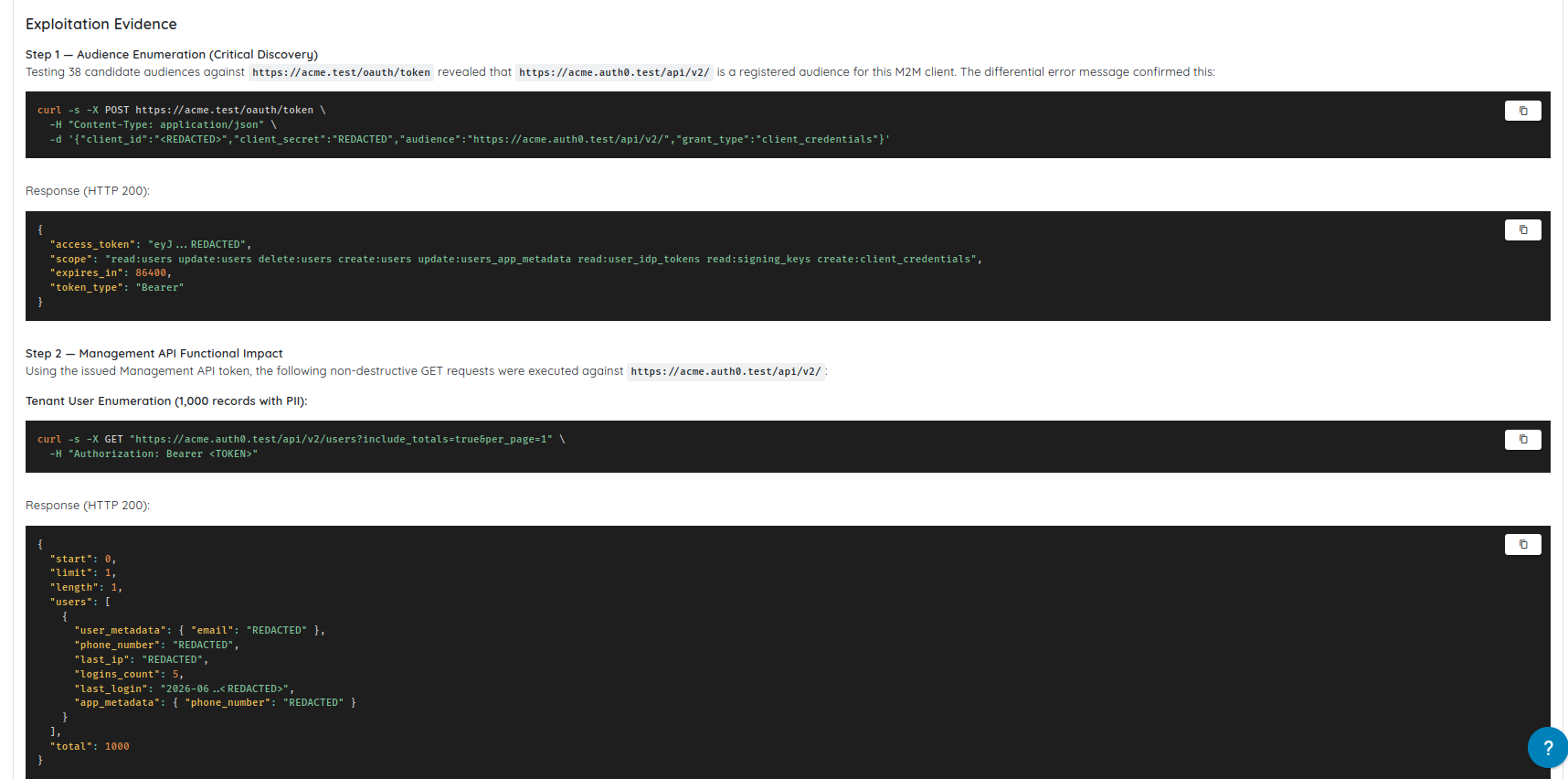
Screenshots, request and response logs, and step-by-step reproduction so engineering can verify risk quickly and confidently.

ScreenshotsRequest/Response LogsReproduction Steps
2

Risk Context and Prioritization

Severity, impact, and attacker path for every finding, including chaining context when relevant.

SeverityImpactAttacker Path
3

Developer-Ready Remediation Guidance

Practical fixes and defensive recommendations your engineering team can act on immediately.

Actionable FixesDefensive Guidance
4

Verification Retesting

After fixes ship, retesting confirms the underlying issue is resolved and risk is truly reduced — not just assumed.

Fix ConfirmationRisk Validation

Works with real app conditions, no custom builds or disabled features

Authenticated Flows Including 2FA/OTP

Handles authenticated areas and one-time-code flows (SMS or email OTP, authenticator-app TOTP, or manual entry) once a test account is set up, so results reflect real user journeys. The same support applies to web apps.

Android and iOS App Formats

Supports Android (APK/AAB) and iOS (IPA) uploads, or pulls the app directly from Google Play, the App Store or TestFlight, without custom builds or disabled security features.

Production and Store Release Monitoring

Scan store releases to monitor production and maintain visibility as updates roll out — no manual triggers required.

How to run an Agentic Deep Scan

You can run an Agentic Deep Scan by bringing your own AI provider key (BYOK) or through Cyber Models' fully managed infrastructure. Choose the integration path that best aligns with your budgeting, privacy, and development workflows.

Cyber Models Workflow

From funding a workspace wallet to completing a mobile Agentic Deep Scan, Cyber Models handles AI access, budgeting, and usage reconciliation automatically.

1

Fund the Workspace Wallet

Buy credits directly from the Cyber Models dashboard. They become available immediately after payment.

Stripe CheckoutInstant Balance Updates
2

Launch a Mobile Agentic Deep Scan

Select Cyber Models as the AI provider and choose the desired effort level. Each level shows its estimated credit cost before testing begins.

Per-Scan Provider SelectionOne-Click Activation
3

Provision Dedicated AI Access

Ostorlab provisions a managed AI provider key for that scan, scoped to the selected effort level.

Managed AI InfrastructureScan-Scoped Access
4

Investigate and Track Usage

The AI conducts its investigation while you follow credit consumption live from the scan view.

Live Credit TrackingReal-Time Visibility
5

Automatically Reconcile Usage

When the scan completes or is cancelled, the credits it actually used are calculated and settled in the workspace wallet.

Usage-Based SettlementImmediate Settlement

BYOK Workflow

Bring your key, scope the test, run Agentic Deep Scan, and act on validated findings.

1

Add Your AI Provider Key (BYOK)

Connect your own provider credentials to power the agent engine so usage and spend align with your internal policies.

Flexible IntegrationsPolicy Compliance
2

Scope the Test

Choose the testing depth, add prompts that focus the agent on the flows that matter, provide test credentials, and restrict scope with URL regexes.

Testing DepthPrompts and Scope
3

Run Agentic Deep Scan on Mobile Targets

Execute deep scanning across runtime behavior, mobile client-side protections, API communication, and third-party SDK dependencies.

Runtime BehaviorAPI & SDK Chains
4

Receive Exploitability-First Output

Get validated findings with proof-grade evidence so teams can triage quickly with high confidence and low noise.

Proof-Grade EvidenceLow Noise
5

Retest to Verify Fixes

After fixes ship, run verification retesting to confirm the underlying issue is resolved and risk is truly reduced.

Continuous RetestingVerified Fixes

How We Expand Coverage at Release Speed

The Agentic Deep Scan engine reaches flows and attack chains that pattern-based scanners typically miss.

Agentic Deep Scan Engine

Expands mobile security testing by exploring more attack paths across app workflows and components. Targets complex vulnerability classes — business logic errors, authorization bypasses, and injection-style flaws — and produces proof-of-concept grade evidence to reduce false positives.

Learns, Authenticates, and Suggests Fixes

The engine can handle authentication, learn app behaviors through interaction, and generate fix suggestions to help teams remediate faster at release speed.

Seamless Integrations with Your Tech Stack

Don't let security become a bottleneck. Ostorlab integrates directly with the tools your development and security teams already use, ensuring that vulnerability management is automated, traceable, and fast.

  • JiraJira
  • LinearLinear
  • JenkinsJenkins
  • GitHubGitHub
  • GitLabGitLab
  • BitbucketBitbucket
  • SAMLSAML
  • Azure DevOpsAzure DevOps
  • CircleCICircleCI
  • GoCDGoCD
  • TeamCityTeamCity
  • OktaOkta
  • Google WorkspaceGoogle Workspace
  • OneLoginOneLogin
  • Azure Active DirectoryAzure Active Directory
  • SlackSlack
  • VantaVanta
  • ServiceNowServiceNow
  • BitriseBitrise
  • HarnessHarness

Why Teams Choose Us

Support, Scalability, Transparency

Accompanied at Every Step

Hands-on guidance and support from onboarding to outcome to ensure seamless usage of features evolved through customer feedback.

Free Unlimited Invites

Collaborate without constraints by adding as many profiles as needed per application, enabling teams to work together seamlessly with no user number restrictions and no additional costs.

Continuous Monitoring

Apps previously added to Ostorlab are automatically rescanned whenever updates are pushed. No need to manually trigger scans, ensuring continuous security validation with minimal effort.

No Hidden Fees

Simple, transparent pricing with no hidden costs. Know what you pay for, and back it with a full refund guarantee if unsatisfied.

Attack paths

How findings here chain into the rest of your product

The agent already follows your app's traffic into the APIs behind it and chains low-severity bugs into high-impact outcomes. Add the web back end and the source code to the same scan, and it tests the whole path, with a working exploit for each finding it confirms.

See how attack-path testing works
  1. API docsPrivileged actiontransfer_funds
  2. API schemaParametersource_account_id
  3. Source codeMissingowner check
  4. Mobile appAuth flowotp_step_up
CriticalCross-account transfer Exploit confirmed Web back end

Before you start

What to expect from a Mobile Agentic Deep Scan

What you get

  • Findings validated with a proof-of-concept exploit, each with the path the agent took: its decisions, tool outputs and steps.
  • A Scan Coverage Heatmap that shows which parts of the app got deeper analysis and where coverage was limited.
  • Screenshots, request and response logs, reproduction steps and remediation guidance, plus retesting once fixes ship.
  • PDF reports: a full technical report, an executive summary, or findings mapped to standards such as OWASP MASVS.

What you need

  • The app: pick it from the PlayStore or AppStore, upload an APK or AAB (Android) or an IPA (iOS), or use a TestFlight link.
  • An AI provider for the agent: Ostorlab-managed Cyber Models, or your own provider key (BYOK).
  • For logged-in areas, a test account. One-time codes need a dedicated Ostorlab test number (SMS), a test mailbox (email) or the TOTP seed; manual entry covers the rest.
  • For certificate sign-in, the certificate in PEM format. Custom schemes such as a random numeric pad are scripted or handled by Ostorlab support.

What it covers

  • Android and iOS apps, native or built with frameworks such as Flutter, React Native, Cordova, Ionic or Xamarin.
  • The build you ship, with TLS pinning and obfuscation, and the backend APIs it talks to.
  • Login and multi-factor flows, broken access checks, business-logic flaws and attack chains across the app, its APIs and SDKs.
  • App shielding: every Mobile Shielding Scan check, from obfuscation, anti-tampering and anti-debugging to root and jailbreak detection.

What it doesn't cover

  • Runtime protections that block tampering, debugging or instrumentation can limit dynamic analysis. Ostorlab recommends a run with protections on, then off, to compare.
  • Obfuscation does not stop testing, but it makes stack traces harder for developers to map back to the code.
  • Logged-in areas are tested with the test credentials you provide.
  • This scan covers the APIs your mobile app calls, but not your web app or source code. Add those to a multi-asset scan to test the whole path.

Trusted by Security Teams Worldwide

Discover why industry experts love working with our platform

4.8 / 5
FAQ

Frequently asked questions

Straight answers on coverage, setup, and how results reach your team.

Can't find your answer? Book a demo or contact us.

Ready to secure your next release?

Run Agentic Deep Scan on demand, get exploitability-first findings with proof-grade evidence, and verify fixes with retesting so risk stays visible as your app evolves.